
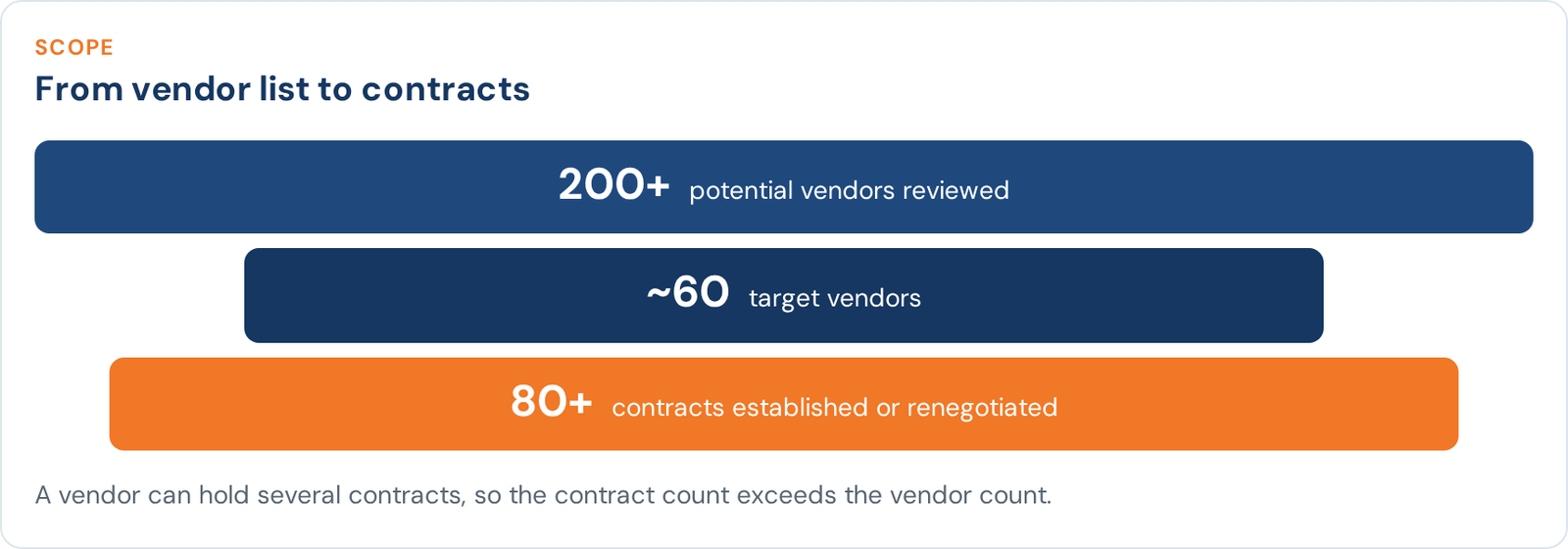
A newly independent specialty retailer had to replace its former parent’s IT contracts with its own. We helped it review 200+ potential vendors and put 80+ contracts in place, each sized to fit.
At a glance
- Client: A newly independent specialty retailer: about 250 stores, about $1 billion in annual sales
- Situation: Divested by its parent to a private equity buyer; IT services ran under a transition services agreement (TSA) with the former parent
- Our role: Sourcing advisor on the buyer’s transition team, working with the company’s IT sourcing leadership
- Scope: 200+ potential vendors reviewed and rationalized; 80+ contracts established or renegotiated
The situation
A national retailer with roughly $11 billion in annual sales divested its ~250-store specialty retail subsidiary (about $1 billion in sales) to a private equity buyer. Much of the new company’s IT ran on the parent’s contracts, covered by a TSA that would end.
Like most private equity firms, the buyer placed trusted interim leaders, project managers, consultants, and lawyers to run the transition. We came in under its direction and worked with the new company’s IT sourcing leadership.
What the company needed
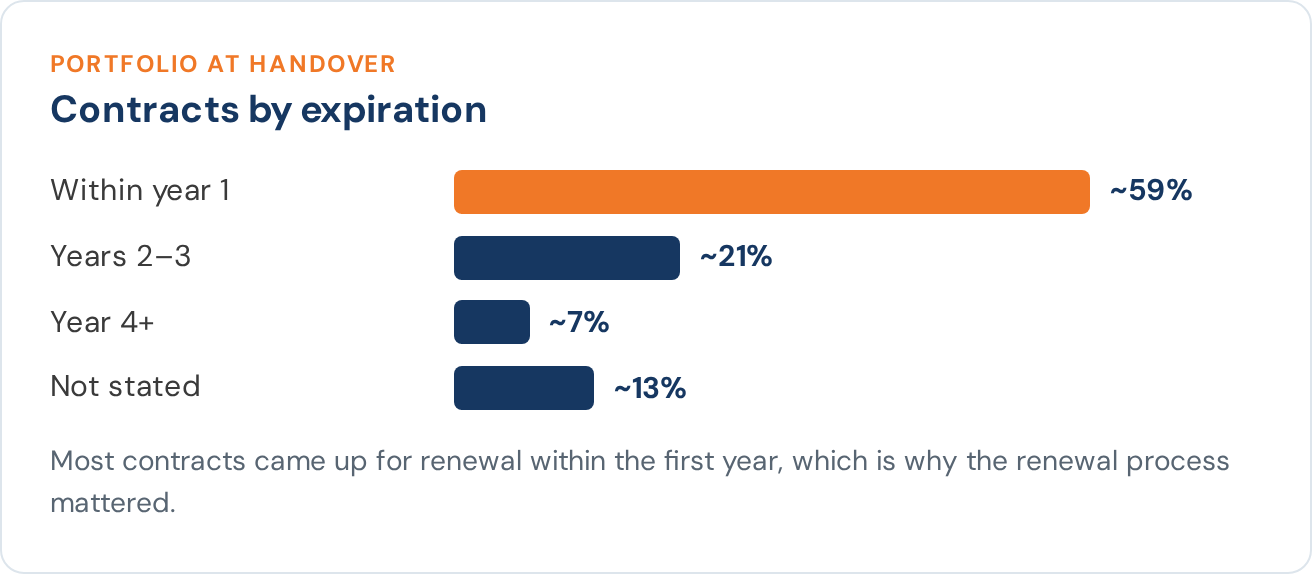
Before the TSA ended, every IT service the business depended on needed a contract the company held itself. Due diligence lists named more than 200 potential vendors. Some legacy contracts could be assigned; others couldn’t. Expirations, scope, and cost were scattered across documents.
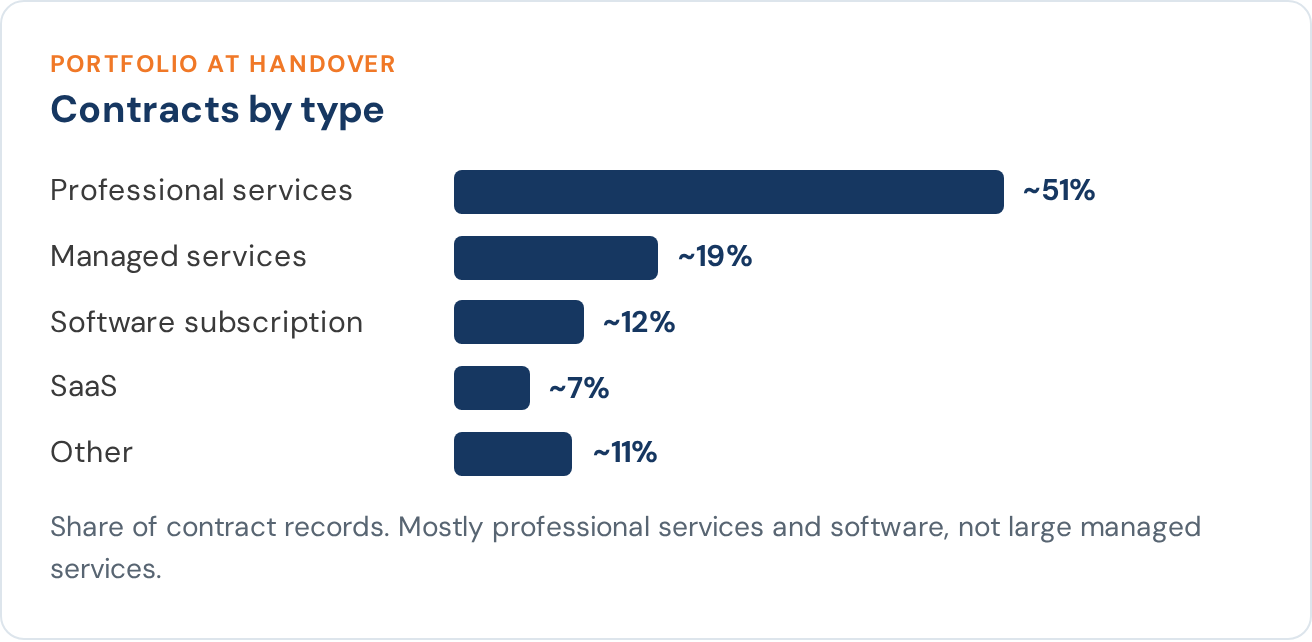
Most of it was small: professional services, software subscriptions, and SaaS. Nothing like the single outsourcing contracts worth tens or hundreds of millions of dollars a year that we usually negotiate. Each still needed clear scope, predictable pricing, a way to flex or exit, and a way to see and fix poor performance. And the company had to run the portfolio itself once the transition team left.
How we helped
Organized what it had. We profiled the legacy contracts: expirations, assignment rights, scope, and cost.
Agreed each contract’s path with its owner. For every vendor we found the business owner and settled the path together: keep, move, replace, renegotiate, or re-source. The list narrowed to about 60 target vendors.
Negotiated to closure. We negotiated directly with providers, reviewed and negotiated statements of work, and tracked open items weekly until each closed. Outside counsel focused where it mattered, and they needed to be engaged less frequently as our engagement continued, as we were able to standardize templates and reviews.
Gave the company its own paper. We built professional services master agreement and statement of work (SOW) forms for the company, along with a contract playbook and a service level strategy.
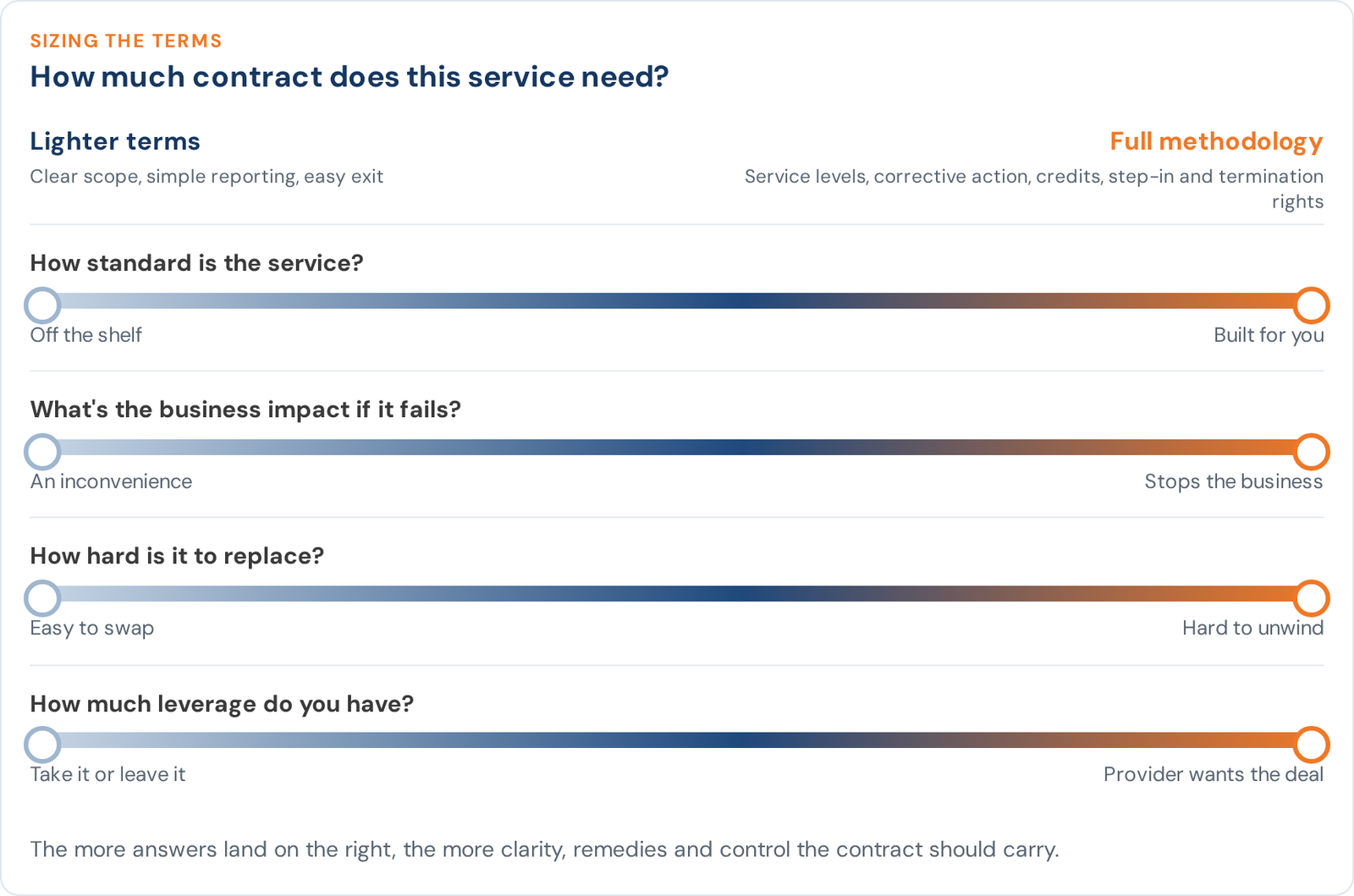
Right-sized the service levels. Service levels in large managed services deals assume a long relationship with a hard-to-replace provider, so they carry a full chain of remedies, from root-cause analysis through credits, step-in rights, and termination. We took that structure apart to see what each piece protects against, then rebuilt it at the right weight for each contract. Where a provider is easy to swap, simple reporting and a clean exit do the job. We still use the calibration approach that came out of this work.
Set it up to run without us. We loaded the contracts into a contract management system and set up a renewal process. A short review guide lets IT, business, and finance staff answer the basic questions themselves: Do I get what I expect? Do I know what I’ll pay? Can I flex volumes or exit? Can I measure and fix problems? Lawyers are saved for liability, indemnity, and new risk.
Results
The company walked away with:
- 80+ contracts established or renegotiated, from a starting list of 200+ potential vendors
- Its own professional services master agreement form, statement of work (SOW) form, contract playbook, and service level strategy
- Its contracts in a contract management system, with a renewal process
- A handover roadmap: templates to build next, an IT business manager role for finance and vendor management, near-term renewals, cleanup of contracts under old legal entities, and portfolio rationalization
- Less reliance on outside counsel over time, as standardized templates and reviews took over routine work
- A team equipped to handle routine contract reviews itself, with a defined role to own the portfolio going forward
- Support beyond the IT contracts, including year-end budgeting and forecasting, and contract work outside IT such as the customer loyalty program
Why it matters for CIOs
Small contracts fail for the same reasons large ones do: scope, price, and quality that don’t line up, and remedies that don’t fit the service, size, or risk. Knowing why each provision in a large managed services deal exists is what lets you give a small statement of work the protection it needs and nothing it doesn’t.
Common small-contract mistakes
- A scope description someone outside the deal couldn’t explain back
- Open-ended “assumptions” that quietly put obligations on you
- Buying outcomes but pricing or reporting hours
- Service credits as the only remedy
- No clean way to reduce volumes or exit
- Pricing units no one can count
- Prepaid or pooled pricing that bills for capacity you don’t use
- Contracts left in the name of an old legal entity
Ready to talk?
Separating from a parent, or carrying more contracts than your team can manage? We can help you size the terms to the risk. Contact us