 Note: this three-part series has been posted as a complete white paper here.
The other postings are available here:
Myth 1: Introducing an Integrator Costs More
Myth 3: Service Integration is just another name for Service Management
Introduction
In Gartner’s “Hype Cycle for IT Infrastructure and Outsourcing Services, 2013”,, Multi-sourcing Service Integration (MSI) or Service Integration and Management (SIAM) is described as sliding into the Trough of Disillusionment. By Gartner’s definitions, that means “because the technology does not live up to its overinflated expectations, it rapidly becomes unfashionable. Media interest wanes, except for a few cautionary tales.” This is often a characteristic of maturing capabilities with relatively low market penetration. To be clear, Gartner’s Hype Cycle curve describes an evolution of service adoption – from initial innovation, to expectations, through disillusionment to enlightenment and productivity. And in fact, they predict that MSI will have passed through this current phase and see mainstream adoption in only 2 to 5 years.
paramount, in our experience. The client governance team must retain overall policy direction, change approvals, and is ultimately accountable within the client to make sure that service providers are performing their contracted functions, as previously discussed. A maturing of cross-functional services will allow the governance team to better focus on their key role of interfacing with and serving their customers.
The Services Integrator takes on the cross-functional services that are inherent in delivering any IT services; these cross-functional services are often based on a standard delivery framework such a ITIL or COBIT. These frameworks provide a solid base from which to allocate roles and responsibilities.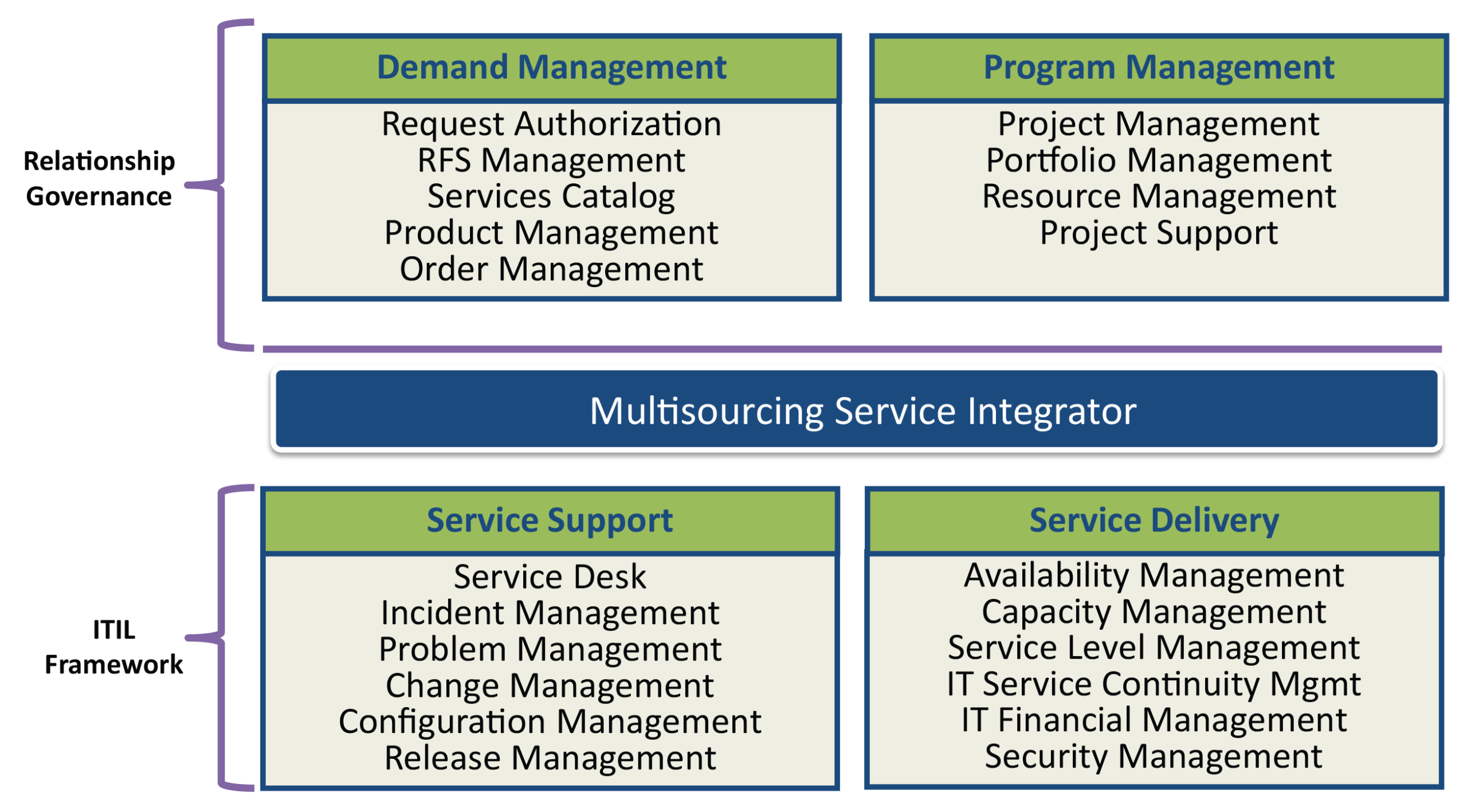
Click image for larger view.
Whatever the model adopted, always assuming that the vision and direction of travel are clear to all involved, a clearly understood allocation of roles and responsibilities should be arrived at and documented. The figure above suggests one such allocation based on ITIL.
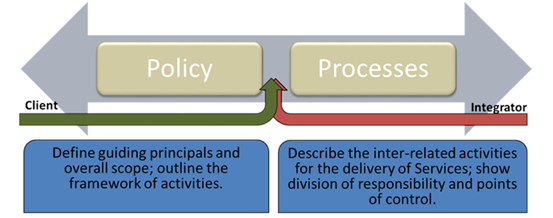
Some of the functions that have traditionally been held by the client’s governance may fall to the Integrator in this process. As illustrated by the figure below, policy will tend to be in the realm of the client and processes in that of the Integrator. I say “tend”, because this is a continuum. It might help to think of the point where the responsibilities of the two parties meet as the button on a slider control – it can be nearer one end or the other as required, and is not permanently fixed in any position over time. Talking to one organisation recently, who are moving towards a hybrid model, they could see how they might initially award more functions to an external organisation, but over time plan to bring more of those functions in-house as their implementation and skills base mature.
Summary
The Service Integrator function is not a substitute for governance, but the agent of Governance, enhancing and maturing its capabilities by performing specialised functions. It is a role that lives primarily in service delivery, performing coordination, validation and verification in support of the governance function. A Service Integrator’s role is to professionalise cross-functional services, enabling the governance function to focus on strategy and on the voice of the business.
It should be separate from both the supply chain and the client in order to give clear accountability, but provided this is clearly documented and understood, it does not necessarily have to be performed by a third party. Hybrid and in-house models can work effectively too. There is not a “one size fits all” solution here, and the model can and should evolve over time to meet changing needs and maturity of operations.
In our next article, we will challenge the belief that Service Integration is just another name for Service Management.